Yes, you can hire a DJ for a fiftieth birthday, a golden wedding anniversary or one of those family reunions that come round every fifteen years. It doesn’t have to be a wedding and there don’t have to be two hundred guests. I do it often, and it’s a different job from a wedding, not a shrunken version of one.
The difference isn’t the repertoire or the size of the rig. It’s that a wedding arrives with a script everyone knows without having read it. Dinner, toast, cake, first dance. A private party has none of that. People turn up at their own pace, nobody is sure when the good part is meant to start and nobody fancies being first on the floor. That’s the real problem to solve, and no song list solves it.
What a private party lacks and a wedding has
At a wedding the roles are already handed out. There’s the couple, who are the centre of everything. There are the parents, who know their turn on the floor is coming. There are the friends, who arrived with the declared intention of finishing late. There’s a photographer setting the pace, a maître announcing that coffee is being served, and an order of events that drags people towards the dancefloor almost on its own.
A sixtieth birthday has nothing like it. No protocol. The person being celebrated is usually uncomfortable being the centre of attention and spends half the night greeting people at the door. Nobody is clear whether this is a long dinner or a party. And until somebody decides it’s a party, it isn’t one.
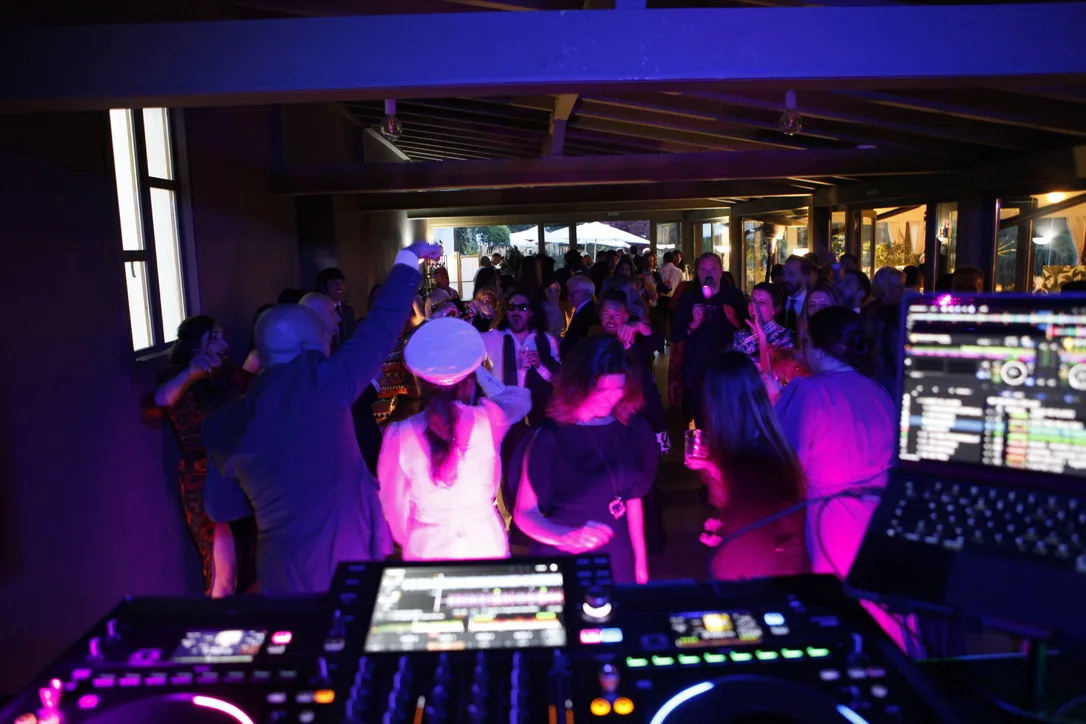
I’ve seen that gap plenty of times. A room full of people standing and chatting, drink in hand, glancing sideways at the empty space at the back. All of them keen. None of them willing to break it in. At a wedding that lasts ten minutes, because the first dance breaks it. At a private party it can last an hour and a half if the DJ just plays familiar tracks and waits.
The real problem is that nobody knows when the party starts
My job there isn’t to be an entertainer. I don’t pick up a microphone or ask for clapping. What I do is prepare the ground so the moment arrives by itself, and recognise it when it does.
An anniversary at a country estate in Villaviciosa, a couple of summers ago. Eighty people, dinner served at half nine, a long spell at the table afterwards with improvised speeches. At midnight they were still sitting down. The easy temptation is to drop a nineties anthem and hope people get up. It almost never works. If the room isn’t ready, you burn the track and then you don’t have it any more.
What I did was lift the pulse of the music very slowly while they were still at the table, without changing world, with things they recognised but with more body to them. The signal came when three women at the back table started moving in their seats and one of them turned round to look at me. There it was. That gesture is the starting gun, and you have to be watching to catch it. Two tracks later there were twenty people standing and the rest came on their own.
That’s reading the room. Not magic intuition. Ten years of watching what people do with their bodies before they decide to move.
Three generations in the same room
The other thing about private parties is the mix of ages. At a wedding the guests usually sit in one dominant age bracket, the couple and their friends. At a family birthday you get grandparents of eighty, children of fifty, grandchildren of twenty and little ones running between the tables. None of those groups wants to hear the same thing, and none of them has to leave at eleven for the party to get going.
The answer isn’t alternating one track for each. People notice, and when they notice they sit down. What I look for is common ground, and there’s more of it than you’d think. There are songs a lad of twenty-five dances to ironically and his sixty-year-old aunt dances to because she danced to them when she was young, and out on the floor you can’t tell the difference. The great soul and disco records work like that. Certain Latin tracks too.
Then there’s an order to it. The first hour of dancing belongs to the older guests, with things they recognise from the first bar. When they start to drift off, around one or half one, the sound can go somewhere else without leaving anyone out. That transition is made by watching the room, not the clock. There are families where the grandparents last until three, and I’m not about to clear them off the floor to follow a plan I wrote at home.
Houses, country estates and basement dens, what changes with the venue
At a wedding the space is usually sorted. There’s a room built for this, with its power supply, its dancefloor and staff who are used to the routine. At private parties in Asturias I find all sorts, and every place shapes the session.
- Bajos and small hired rooms in Gijón or Oviedo. A bajo is a ground-floor or semi-basement space, often rented long term by a group of friends as a private den. Very common here. Short space, low ceiling, plenty of reverb. High volume backfires, because people stop hearing each other and go outside for a cigarette. You work with less bass pressure and the booth close to the floor.
- Country estates and llagares. A llagar is an Asturian cider house, where the cider is pressed and drunk on site. The dancing usually happens in an open or half-open space. Sound escapes, so the rig has to be placed properly and you have to accept that at three in the morning the neighbours have a right to sleep. Ask about the cut-off time before you confirm the date.
- Private homes. The first thing I check is the electrics. An old house with a bare-minimum installation and an oversized rig means a tripped fuse box halfway through a track. I bring equipment sized for that room, not the same setup every time.
- Sidrerías and restaurants with a function room. A sidrería is a cider house restaurant, the standard place to eat and drink in Asturias. The schedule rules. If the kitchen closes at one, the party starts late and has to be compressed. I’d rather know beforehand, so I can build the session the other way round and come in harder from the start.
If what you have in mind is an afternoon celebration, which is very popular in Asturias, the approach changes again and I go through it on the sunset sessions page.
What I need to know before accepting a private party
With weddings I have a set of questions I always use, and I wrote about it in what I ask couples before accepting a wedding. At private parties the questions change, because what’s at stake changes.
Who the people are. Not how many, but what ages and where they’ve come from. Eighty people from the same group of lifelong friends is nothing like eighty people from an extended family.
What exactly is being celebrated and who organised it. A birthday somebody threw for themselves isn’t the same as a surprise one put together by their children. In the second case the guest of honour arrives thrown off balance and needs half an hour to settle into their own party.
What happens before I start. Whether there’s a sit-down dinner, speeches, a video screening or a cake. All of that marks the point where I take over the room and the state it gets handed to me in.
What music has always been played in that house. This is the question that helps me most. Families have their own soundtracks, songs that go on at every Christmas lunch. If you tell me what they are, I have an anchor no chart list can give me.
How late we can go. Because of neighbours, the venue licence or the bus taking people home. A four-hour party and a seven-hour party aren’t built the same way.
With that ready, I arrive knowing where I’m going to start and with room to change plan the moment the party tells me otherwise. If you’re organising something along these lines, on the DJ for private parties in Asturias page I explain how I work and how dates are booked.
What people ask me before booking
There’s no minimum number of guests. I’ve played for thirty people and it worked. What matters is the kind of celebration, not the headcount. With small groups the work is finer, because anyone who sits down is very visible, and the session runs at lower volume and closer to the people.
A private home or a bajo works, and it’s more common than you’d think. I need to know the size of the room beforehand, whether there’s enough power and what time we have to stop for the neighbours. With those three things I bring a rig sized for that space.
You can send me a list, and it genuinely helps: the songs that can’t be missing and the ones you don’t want to hear under any circumstances. What I don’t do is play a closed list from top to bottom, because then I can’t react to what’s happening in the room, which is exactly what you’re hiring me for.
The length depends on when dinner finishes and on the venue’s cut-off time. At a private party the window is usually shorter than at a wedding, and that has to be factored into the plan. On notice, weekends from May to September fill up early because they overlap with the wedding season. For the rest of the year there’s usually more room.