Many couples arrive at the first call with the same phrase — “we want something different, but that works for everyone”. Behind that phrase there’s a clear musical identity and a reasonable fear: that the uncles in their 60s stay sat down, that the floor empties at 00:30, that the family brings it up for years to come. This post explains how to build a wedding with an electronic soul — house, disco, deep, melodic techno — without sacrificing the guest who came to dance the old classics. With taste. Without clichés.
The mistake of mixing genres without taste
A wedding floor doesn’t break because of the genre. It breaks because of a failure to read the room. I’ve seen weddings with reggaeton and bachata where no one dances, and weddings with deep house where at three a.m. there are still 80 people on the floor. The common factor isn’t the style, it’s who decides what plays and when.
Why an automated playlist never works at a wedding
A Spotify-ordered playlist doesn’t know the bride’s father has just sat down, that the uni friends have been waiting ten minutes for a drop, or that grandma just warmed up with the first 80s track. Press play and pray. At a wedding of 150 people across different ages, that’s a bad bet.
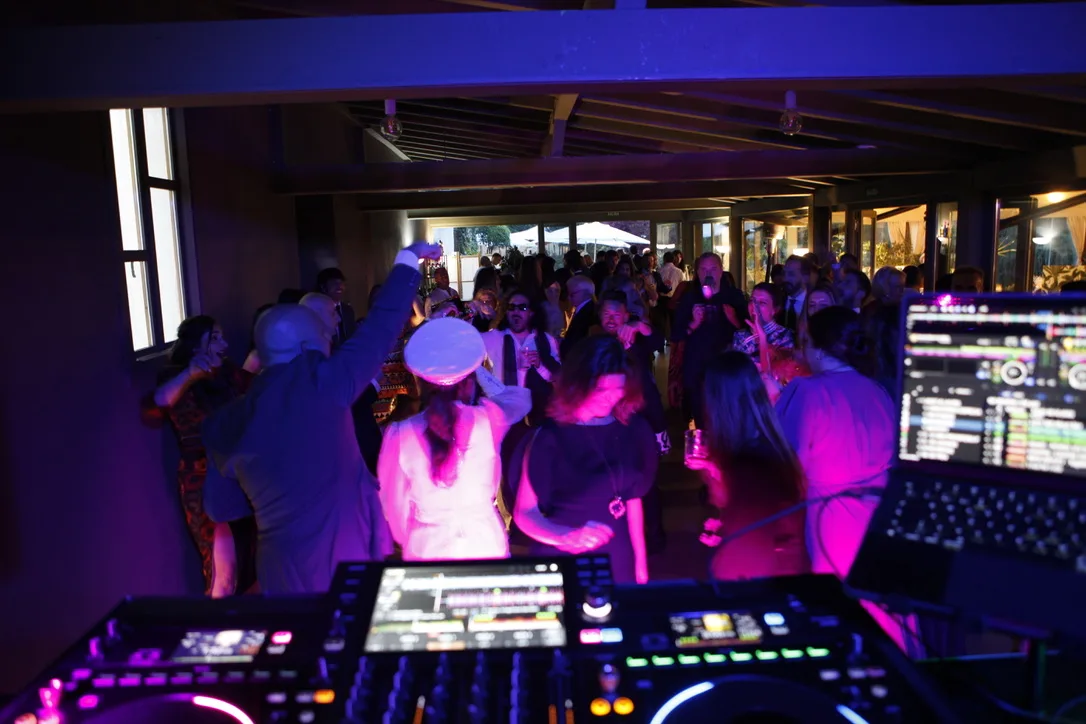
Mixing live isn’t a technical flex — it’s the only honest way to respond to what’s happening in the room. If at 23:15 the floor asks for something slower, I play it. If at 00:40 there’s energy to push into deep house, I push. A playlist doesn’t do that. I go deeper into what a Spotify playlist can’t do.
The difference between imposing the style and building from it
Having your own style doesn’t mean imposing a club set on top of a wedding. It means having a clear sonic map — disco, funk, deep, soul, melodic techno — and knowing where to enter and when. The difference between a DJ with taste and a DJ with a playlist is exactly that: the second plays their own taste; the first uses it as a language to build someone else’s night.
What house, disco and deep have that connects with everyone
Here’s the key almost no one tells you: house and disco aren’t “new” genres. They’re direct heirs of 70s and 80s funk, soul and R&B. Older guests recognise those frequencies — the round bass, the swinging snare, the soul vocal — even if they don’t know the name of the genre they’re listening to.
Disco and funk — the bridge between generations
ABBA, Donna Summer, Candi Staton, Chic, Earth Wind & Fire. Grandma dances to this and so does the 28-year-old cousin who listens to techno at Sónar. Disco is one of the few dance-floor genres that has never left popular culture. If you use it as the backbone of the first part of the night, half the work is done.
And when you move from there to a modern edit of a disco classic — a Hot Chip remix over a 70s track, for example — the transition is invisible to the general listener. The body keeps dancing to the same thing; the set is already moving into more current territory.
Deep house — why it sounds familiar without being commercial
Good deep house leans on electric-piano chords, funk bass lines and vocals with soul roots. It’s not aggressive. It’s not “airport club”. Heard without context, a 60-year-old guest couldn’t tell whether it’s two years old or thirty — and that ambiguity is exactly what makes it work at a wedding.
Not all deep house works, though. Deep with 80s-style vocal house, organic instrumentation and restrained tempo (117–122 BPM) is what fits. Deep minimal, instrumental and cold, doesn’t.
Melodic techno — for the close, when only those who want to keep going are left
Melodic techno isn’t for the opening or the golden hour. It’s for the close. When the floor is already hot, the grandparents have gone to bed happy, and only 40 or 50 guests are left who don’t want the night to end. That’s where: Âme, Tale Of Us, Mind Against, Agents Of Time. Texture, melody, tension. Festival close, not standard wedding close.
If you drop melodic techno at 23:30, you empty the floor. If you drop it at 02:30 after an hour of well-built house, you wrap up the night with something people will remember.
How an inclusive wedding floor is built
Building the session in phases isn’t a textbook formula — it’s common sense applied to the real energy curve of a wedding. There are three moments and each asks for different things.
The first hour, when everyone’s watching
Just onto the floor, people watch more than they dance. You don’t open with a banger — you open with something that invites without attacking. Classic disco, soul with groove, some well-placed latin. Celia Cruz works. Stevie Wonder works. A soft Chaka Khan edit works. What doesn’t work is opening with a drop.
The goal of this hour isn’t to fill the floor to 100%. It’s to settle the hesitant — the aunt who isn’t sure whether to dance, the serious friend who needs two songs to loosen up. If something they recognise plays here, they come in.
The golden hour, when the floor cracks open
Between 01:00 and 02:00, depending on the wedding, the window opens where everything’s possible. This is where musical taste makes the difference. The floor is loaded, there’s trust, and the DJ can start pushing toward less obvious sounds. Nu-disco, disco house, deep with vocal, afro house in short doses. The older guests keep dancing because the pulse is the same; the younger ones lift because the sound is no longer what played at their parents’ wedding.
This isn’t improvised. This is read. If the golden hour doesn’t open, you don’t force it — you go back to disco and wait. With couples who mix electronic with guitars, I also work indie weddings in this same stretch.
The close, for those who don’t want it to end
The close is the DJ’s territory. In this stretch, the guests who remain are the ones who came to dance. Here’s where melodic techno fits, longer afro house, more hypnotic deep. This isn’t the moment for crowd-pleasers — it’s the moment to close the session with identity.
If your wedding fits this approach and you want to hear how it sounds before deciding, you can listen to the current queue on the music style page.
What sets a wedding with musical taste apart
It isn’t the gear. It isn’t the years in the trade. It’s how the session is prepared before the day and how the room is read during.
The previous meeting — listening before proposing
Before proposing anything, I ask. How you met, which song can’t be missing, what you don’t want to hear under any circumstances, which weddings you’ve hated and why. From there a map comes out — not a closed playlist, a map. With that map I build the skeleton of the session, knowing that the final 30% is decided live watching who’s in the room.
This is the opposite of arriving with a pre-rendered USB. And it’s what makes a couple with demanding musical taste feel heard rather than served. From that meeting on, I translate all of this into a setlist with taste.
Requests yes, but with taste
Guest requests are part of the game. But not all of them come in. If someone asks for something that breaks the flow of the golden hour, I note it to drop three tracks later, when it fits. If someone asks for something the couple has explicitly forbidden, it doesn’t play. Taste isn’t saying yes to everything — it’s knowing when a yes helps the floor and when it sinks it.
Three weddings that seemed impossible to square
Wedding at an Asturian estate, 140 guests, couple obsessed with deep house and a very traditional family. The challenge: getting the groom’s uncles — all over 60 — to dance. Solution: first hour loaded with 70s disco and soul. At 01:15 I started introducing deep house with classic vocal house (soul vocals over house base) — the uncles stayed on the floor without noticing the change. The groom told me afterwards that his dad, who in theory hated electronic music, was dancing until three.
Wedding of 90 people, couple who wanted techno from minute one. Here I had to say no. Technically you could do it, but with 90 guests and half of them over 55, starting with techno would have emptied the floor the first hour and recovering it would have been almost impossible. We made a new map: disco and funk at the start, deep organic in the golden hour, melodic techno only in the close. The couple danced their techno; the family danced the whole night.
Wedding in Oviedo, indie couple with 200-song Spotify lists. The risk was turning the session into an indie-pop karaoke without floor energy. I used their songs as anchors — four or five at specific moments — and built the rest with indie electronic, nu-disco and melodic house. Their songs played, but inside a session that had a pulse. At two a.m. no one missed the other 195 songs on their list.
Is your wedding a candidate for this approach?
Not every wedding fits this way of working, and I prefer to say it clearly.
If you want reggaeton and bachata from 10 p.m. to close, I’m not your DJ. It’s not a judgment, it’s a question of fit. There are excellent professionals who do that very well — I’m not one of them.
If you want a “neutral” DJ who plays whatever people request without filter, same. My job starts where pleasing everyone ends.
If you’re as clear about what you don’t want to hear as about what you do; if you care that the music has taste and not just volume; if you want a floor that doesn’t empty but also doesn’t sound like an airport club — then yes, we’re speaking the same language. And the conversation will probably be short and easy.
If your wedding fits, we can check availability.
Check availability for your date
Frequently asked questions
Can a wedding really work with house or deep house music? Yes. House has roots in funk and soul that older people recognise without knowing they’re recognising it. The key isn’t in the genre — it’s in how it’s introduced and when.
What do I do if my older guests don’t know electronic music? They don’t need to know it. The disco, funk and R&B of the 70s and 80s are the foundation on which much of current house is built. The bridge is there; you just have to know how to use it.
Can a wedding with alternative music work for 150 people of different ages? If it’s built well, yes. What determines success isn’t the genre — it’s reading the room in real time and building in phases. A well-designed session doesn’t impose, it guides.
When in the night does it make sense to introduce melodic techno? At the close, when the floor is already hot and only those who really want to keep going are left. It’s not for the opening, it’s to wrap up.
How do I know if my wedding fits this musical approach? If you’re as clear about what you don’t want to hear as about what you do, it probably fits. If you care that the music has taste and not just volume, same. If you want a floor that doesn’t empty but doesn’t sound like an airport club either, we’re speaking the same language.