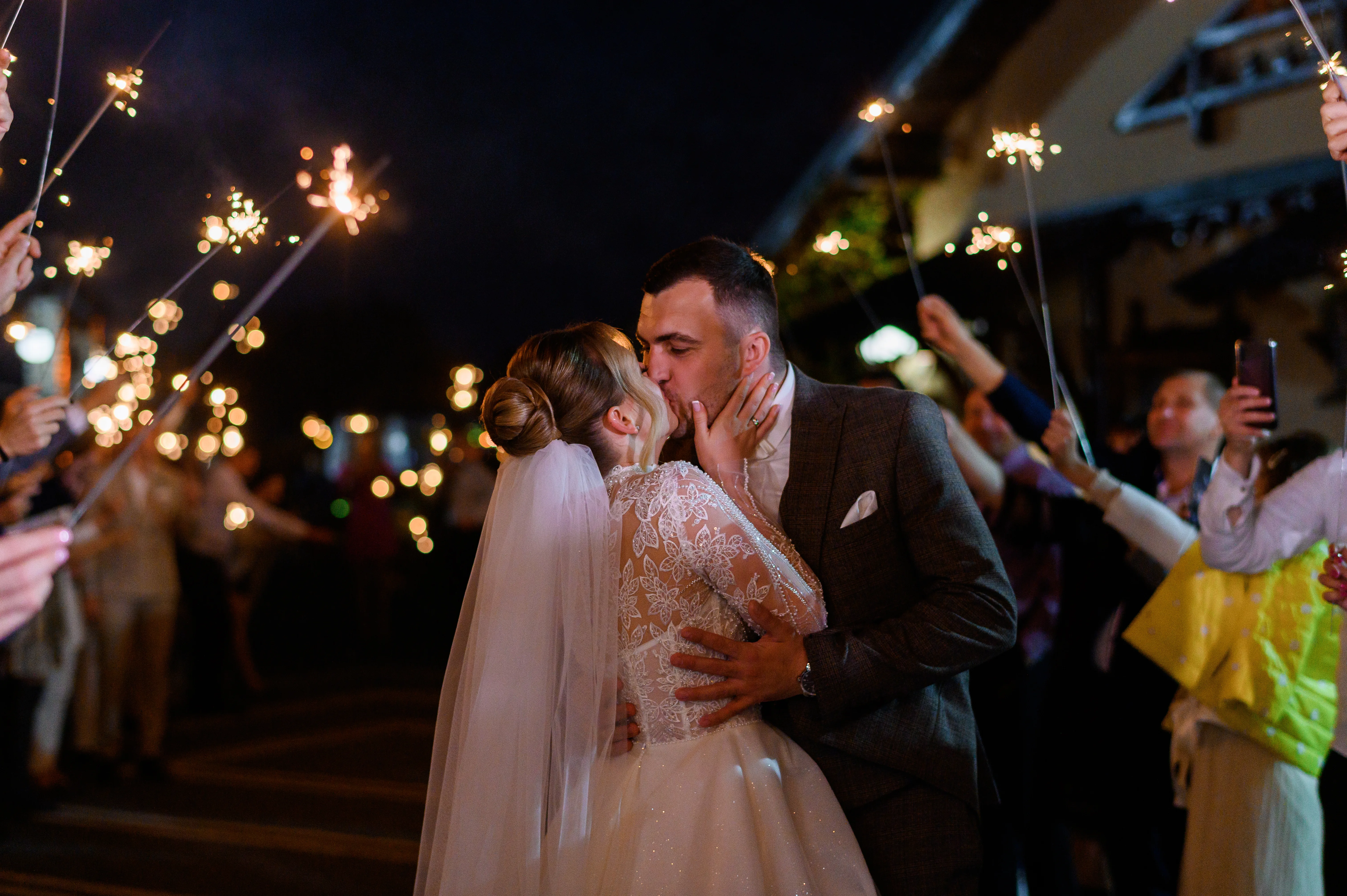
There’s one phrase I hear almost every week on the first call. They say it quietly, almost apologetically.
“We don’t want the typical wedding music.”
They say it because they’ve been to five, ten, twenty weddings. And they know exactly what the typical wedding music sounds like. The Macarena at eleven. Some tired sing-along hit at midnight. A half-hearted reggaeton at two when no one’s dancing anymore. The floor empty at three because the DJ has spent the last hour playing what he feels like and forgot to look at who’s still in the room.
I’m not going to tell you anything you don’t already know. This post is for people who already know it and are looking for something else.
There are two kinds of wedding
I’m not talking about budget. I’m not talking about decoration style. I’m talking about what happens from ten p.m. onwards, when the bar opens and people start to move. Or not.
The one people endure
It’s the wedding where guests do their duty. They dance for half an hour because it’s expected, because it’s your cousin’s wedding, because the bride has gone to the trouble of organising everything and you have to respond. But at two a.m. the floor is empty, the tables are full, and the groups have retreated to the corner of the garden to smoke and talk about their stuff.
Nothing bad happens. No one fights. The couple doesn’t complain the next day because they’re exhausted and, above all, because they don’t know it could have been different. They assume weddings are just like that.
The one people remember
It’s the other one. The one that, three years later, at a dinner with friends, someone brings up: remember Lucía and Javier’s wedding, when that track dropped at three and it all kicked off?
No one remembers the catering. No one remembers the table decorations. They remember how they felt. And how they felt has everything to do — very directly — with the music that was playing when they felt that way.
The difference between one wedding and the other is almost never in the budget. It’s in who decided what plays and when.
Why wedding music is almost always boring
I’ll be direct. Most weddings have the music they have because no one really thought it through.
The problem isn’t the song, it’s the lack of taste
There are no bad songs for a wedding. There are bad decisions. Playing Despacito at eleven p.m. isn’t bad because it’s Despacito. It’s bad because it’s predictable, because anyone would play it, because it’s already playing at 80% of weddings in this country.
When everything is predictable, music stops building something. It becomes background noise while people eat, drink and chat. Nobody really dances to what they’ve heard in the car a thousand times that same month.
Taste is the opposite of the downloadable playlist called “the best songs for weddings 2026”. Taste is knowing why you’re playing that specific song right now.
A playlist isn’t a session
You can build a six-hour Spotify playlist of your favourite songs. You can order them logically and ask someone to hit play. It’ll cost you nothing and, on paper, it looks like it’ll work.
It won’t work.
A playlist is a list of songs stuck one after another. A session is what happens when someone is reading the floor in real time and decides whether song 7 moves up, moves back, or just doesn’t play because two tables are getting up and need to be held another ten minutes.
A playlist doesn’t know your aunt Mari got emotional during the toast and needs three calmer songs to compose herself before the drop. A playlist doesn’t change genre when it sees the young group went to the bar and only the parents are left on the floor. A playlist doesn’t mix, doesn’t transition, doesn’t breathe.
This isn’t an opinion. It’s what separates a record played by a human from a folder of MP3s played in order. I go into more detail in why Spotify can’t handle a wedding.
Reading the floor is a craft, not a talent
People talk about “reading the floor” as if it were some mysterious gift. It isn’t. It’s a craft. You learn it by playing many nights, getting it wrong, watching what works in a 40-person room and what works in a 200-person room, what happens at midnight and what happens at four.
More than 200 weddings since 2015, one per weekend most years. That’s the number that gives me what I know. It’s not talent. It’s hours.
What looks like magic at a wedding where the floor doesn’t empty all night is, in reality, someone who has watched enough floors to know where the room is at every moment.
What makes a wedding with musical identity different
It isn’t about playing “alternative” music to seem modern. It’s something else.
Music doesn’t fill, it builds
At a well-thought-out wedding, the music moves in layers. The ceremony doesn’t sound like the cocktail. The cocktail doesn’t sound like the dinner. The dinner doesn’t sound like the golden dancing hour. And the golden hour doesn’t sound like the after.
Each moment has a different emotional function and needs a different sonic family. Soul and neo-soul for the cocktail. Disco and funk to crack the floor open. Deep house and organic house to hold it once it’s been running an hour. Something more tribal, afro house or melodic techno, for those who want to keep going at four.
It isn’t a list of genres for show. It’s a logical chain. Each block prepares the next.
Your taste has a place, but doesn’t run the show alone
Send me your favourite music. Tell me the song that can’t be missing and the one you don’t want to hear under any circumstances. That’s sacred and gets respected.
But a full session made only of your favourite songs isn’t a good session. It’s an emotional karaoke for two people. And at your wedding there are 80, 120, 200 other people.
My job is to take what identifies you, understand the energy you want, and build around that a session that also works for your 19-year-old cousin who listens to drum and bass and for your 68-year-old godmother who danced at Pachá in 1995. Without betraying your taste. Without betraying the floor.
From the 60s to today without a single jarring moment
A good session goes from Candi Staton to a recent remix without anyone noticing the seam. From ABBA to a deep house track with a 2020s vocal without grandma leaving the floor. From Rosalía to Celia Cruz without it feeling like we’ve switched weddings.
This is called sonic coherence. And it’s what turns six hours of music into a single night, not six disconnected blocks with awkward silences between them. A concrete example: this is how I build weddings with electronic soul that don’t leave older guests behind.
If any of this resonates, let’s talk. No commitment, no 12-field form. Tell me about it here.
Which couple this is for
I’m aware this way of working isn’t for everyone. I don’t pretend it is. I’d rather work with 40 couples a year who fit than with 80 who regret it three months later.
If you hate mandatory commercial pop
If the idea of the summer’s latest hit playing at your wedding gives you a small shiver, we’re on the same page. I won’t play it. Not because I don’t know how, but because it doesn’t make sense at your wedding.
There are more interesting ways to fill the floor. And there’s plenty of excellent, danceable, recognisable music that isn’t on this week’s Spotify top 50.
If you want guests talking about the music the next day
At some weddings, the next day, people send a message: hey, what was that song when you walked into the venue? Or: what was that remix at three in the morning?
That’s the indicator. When music goes from decoration to memory, something went right.
If for you the wedding is an experience, not a protocol
Some couples organise a wedding because it’s what you do. They tick the boxes: ceremony, cocktail, dinner, dancing, open bar. Done.
Other couples organise it because they want to gather the people who matter most to them in one place and give them a night they’ll remember. That difference changes everything. Including the music.
If you’re in the second group, we’re probably meant to work together.
How I work a wedding
There isn’t a closed methodology. There are three moments I take very seriously.
The first conversation
We don’t start by talking about music. We start by talking about you. How you met, what kind of people will be at the wedding, what weddings you’ve endured and what you don’t want to repeat.
From that come more musical decisions than from any song list. If you tell me your group of friends is a festival crowd, I already know where the two a.m. stretch will go. If you tell me half the family is Argentinian, I know at some point electronic tango or great salsa will have to come in.
The musical map
Before the wedding we work a document together. Not a closed list of 80 songs, but a map. What sonic family for each moment. What songs are essential to you. What songs are forbidden. What artists are vetoed. What specific moment you want to be special and why.
It’s a few weeks of work, not a quick email. But without that map there’s no bespoke session. There’s improvisation, and improvisation at weddings tends to end badly. If you want the detail, here’s how I build the bespoke setlist with each couple.
The day in real time
On the wedding day I’m the person watching the floor while you’re watching your grandmother cry with joy. That’s my job, not yours.
If a song on the map isn’t working, I don’t force it. If one that wasn’t planned comes to me because I see something in the room, I play it. If a moment is cooling down, I step in before the floor dies.
You don’t have to worry about the music that day. You have to dance.
Questions people always ask
What kind of music do you play at a wedding when the couple has alternative taste?
It depends a lot on how alternative the taste is and on what the audience looks like. If the couple listens to indie and electronic and most guests do too, the session goes straight there. If the couple is more alternative but the audience is very mixed, I build a bridge: I start with recognisable, danceable tracks (disco, soul, funk) and open up the spectrum as the night progresses and the floor is already hot. The couple’s alternative taste shows, but doesn’t crash in at the start.
How do you make older guests enjoy it too if the music is more alternative?
Older people aren’t a monolith. Your 65-year-old aunt danced very danceable things in her youth: disco, soul, Motown, classic Spanish pop, salsa, boleros. I can play all of that with taste and it works perfectly next to a current remix if the transition is well done. The mistake is thinking that older people need the typical wedding music. The typical wedding music isn’t music they enjoy, it’s music they assume they have to endure. Playing something with quality that they recognise works better almost every time.
Do you accept a closed song list?
Yes and no. Yes to essential songs, forbidden songs and vetoed artists. No to a closed six-hour list in order. If someone wants that, they don’t need me. They can hire a cheaper sound service and have someone hit play on the playlist. What I bring is precisely the ability to decide in real time what plays. If you take that decision away from me, I’m not doing my job.
What’s the difference between what you do and running Spotify at a wedding?
A lot. Spotify doesn’t mix: it cuts one song and starts the next. Spotify doesn’t read the floor: it plays what’s on the list, even if the room is emptying. Spotify doesn’t adjust intensity to the moment of the night. Spotify doesn’t have five different versions of the same track to choose the one that fits. Spotify doesn’t know when to drop the volume so a toast can be heard and raise it right after to keep the energy. And most importantly: Spotify doesn’t respond to what’s happening in that specific room that specific night. It plays the same it would play at any other. A wedding isn’t any other.
Which kind of couple gets the most out of hiring you?
Couples who take music seriously and have listened to enough to notice the difference between something well played and something just played. Couples who have been to concerts, festivals, good-sounding clubs, and want to bring some of that energy to their wedding. Couples who prefer to pay more and have fewer doubts rather than pay less and pray. If any of those three fit, we probably fit.
A wedding lasts six or eight hours. You have months ahead to decide who is going to build the soundtrack of those hours.
If you’d like to talk it through, tell me how you imagine the night. Twenty minutes of conversation clear a lot of things up. Write to me here.
See you on the floor.
—María